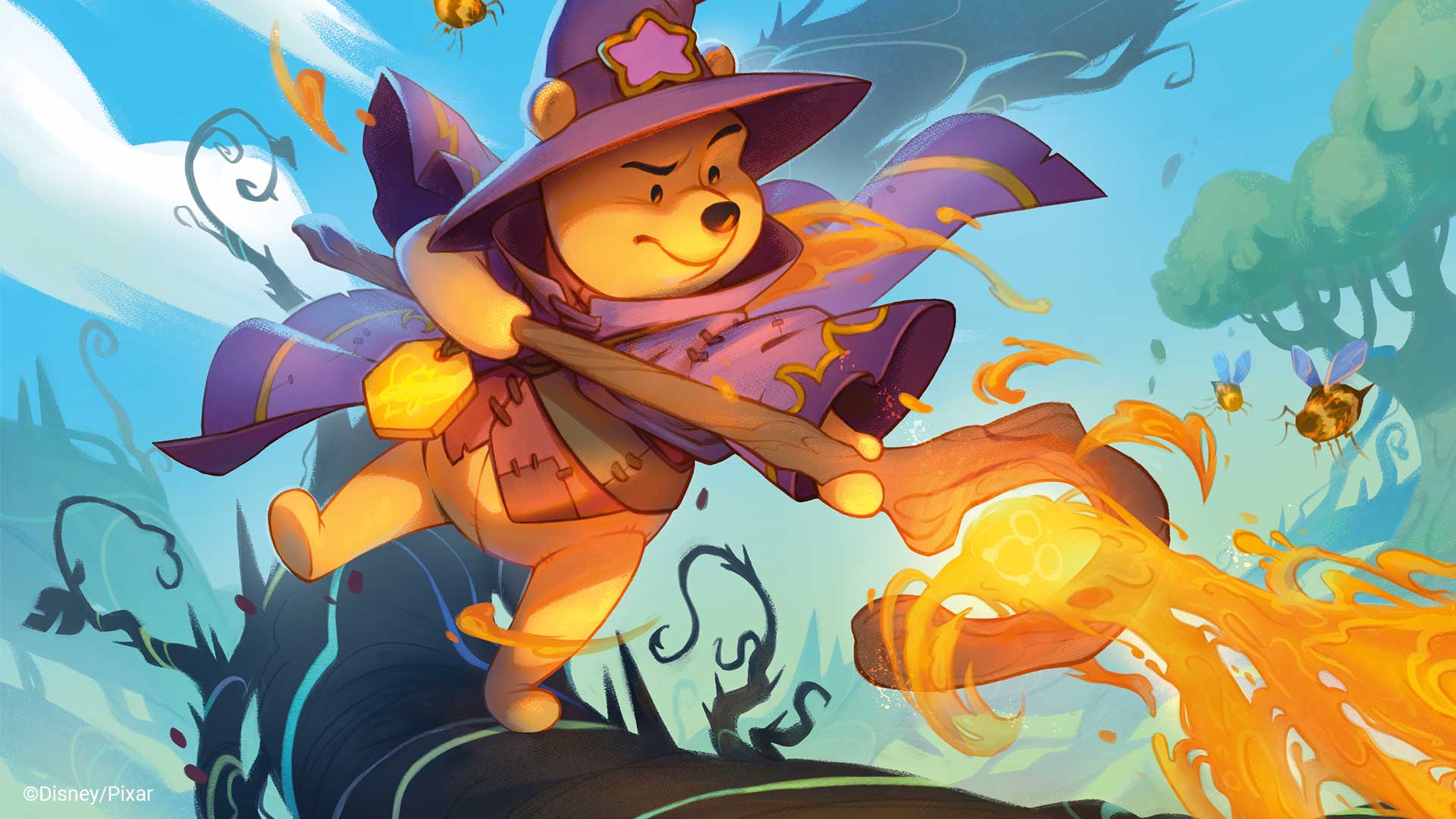
Posey – Vampire Potato
Emerald character
Storyborn • Monster
7 cost, inkable
7/8/2
Potato Shift 5 {I} (You may pay 5 {I} to play this on top of one of your items named Potato.)
Until now, you could only shift a character on top of another character. Posey – Vampire Potato changes that. After all, it’s only right that she should be able to shift onto a Potato even though it’s only a Potato—that is, an item.
This change required the following Potato-related rules adjustments:
• When you shift Posey on top of a Potato that was in play at the start of your turn, Posey can quest, challenge, sing, and take all the normal actions that a character can do.
• If you play a Potato and then shift Posey on top of it during the same turn, Posey is
considered to be drying and can’t quest, challenge, sing, or take normal character actions.
Think we can say “potato” any more?
Potato.
Rules Clarifications
With our previous set, Wilds Unknown, we released the “2.1” version of the Disney Lorcana Comprehensive Rules. This technical document covers the intricate details and nuances of playing the game.
The 2.1 version featured a list of clarity and functionality updates from the 2.0 update. With 2.2, we’ve continued to make updates to improve the readability and functionality of the Comprehensive Rules. Here are the tune-ups we made with the release of Attack of the Vine!
More Damage Language
The most recent updates to the damage section achieved what we’d hoped, with improved clarity and a more intuitive framework. This round, we codified the damage calculation process and consolidated it in one part of the rules. Changes include:
• A new section defining the process of damage calculation for both damage from
challenges and damage from resolving effects.
• Additional clarity regarding when something “deals” damage versus when something
“takes” damage.
• Further helpful examples.
It’s important to note that nothing has changed in how dealing damage is calculated. It simply lives in one spot now rather than being spread across different sections of the rules.
Conditional Dependent Effects
Previously, these definitions only existed in the static abilities section, which meant they only applied to static abilities. The definitions were meant to apply to all types of abilities, so we moved them out of the rules about static abilities and into a more general section. This doesn’t change how any cards interact, but it should provide clearer interpretations of how certain effects work. This change included:
• Updating the terminology from conditional static abilities to conditional dependent
effects.
• Moving rules from 6.4 to 6.1, with language updated to reflect this.
Minor Rules Updates
With this new set we’ve also made the following general updates to the Disney Lorcana TCG
Comprehensive Rules:
• 1.10.1.3. Added language detailing the rules for cards whose abilities adjust deck
construction.
• 4.3.4.2. Added language clarifying that triggered abilities that occur from a card being played on top of a card with a triggered ability align with on-play triggered abilities.
• 4.3.6. Adjusted the wording in the example to clarify that the payment reduction still
applies to a character that’s played for free.
• 4.6.4.4. Added language explaining what happens if a character in a challenge is readied during that challenge.
• 5.1.1.7. Added language explaining that cards under a top card gain the states of the top card when that top card moves zones.
• 5.3.3.2. Added new classifications: Boss, Red Panda, Team, and Vineling.
• 5.5.3. Added language stating that an item can have additional classifications.
• 5.6.3. Added language stating that a location can have additional classifications.
• 6.1.4.1. Added language to clarify that when an effect has a cost and “may,” if the player
chooses not to or can’t pay the cost it’s treated the same way as if the player chose “no.”
• 6.7.2. Added language defining exactly when an ink payment is made during the steps of resolving an effect.
• 6.7.2.1. Added language defining choices that are made when a secondary “if” condition is checked.
• 8.4.1. Adjusted language to further define the Boost keyword, but its functionality remains unchanged.
• 8.8.2. Adjusted language to reflect the proper terminology in correlation with the updated damage rules.
• 8.10.4.1. Added language explaining what happens when a shifted character is put on top of a non-character.
• 8.10.4.2. Added language explaining what happens when a shifted character is put on top of two characters with conflicting states.
• 8.10.9. Added language that explains what happens if a card has two or more Shift
variants combined into a single ability.
Quality-of-Life Updates
The following updates are adjustments to language and word usage within the rules and on the
cards to be clear, concise, and consistent.
• 4.6.6.1. Adjusted the section reference numbers to the updated damage rules.
• 4.6.6.2. Adjusted the section reference numbers to the updated damage rules.
• 5.1.3. Adjusted the section reference number in the example.
• 6.1.6. Adjusted the example to include both “another” and “other.”
• 6.1.10. Added a new example.
• 6.7.2.2. Adjusted language to match the related sections.
• 8.10. Adjusted several instances of “character” to “card” throughout this section.
• 8.10.8. Added new Shift variants to the section.
• 8.10.8.1. Added “[Classification]” to the definition.
• 8.10.8.2. Added “Universal” to the definition.
• 8.12.1. Adjusted the definition to match the language used for songs.
Card-Specific Notes
The following are answers to a few questions that might come up when playing specific cards from this new set. This isn’t meant to be an exhaustive list, but we hope it’s a helpful guide for some of the more complex cards.
Woody – Helping a Friend